Lead Generation
Sales prospecting: research the account before writing the message
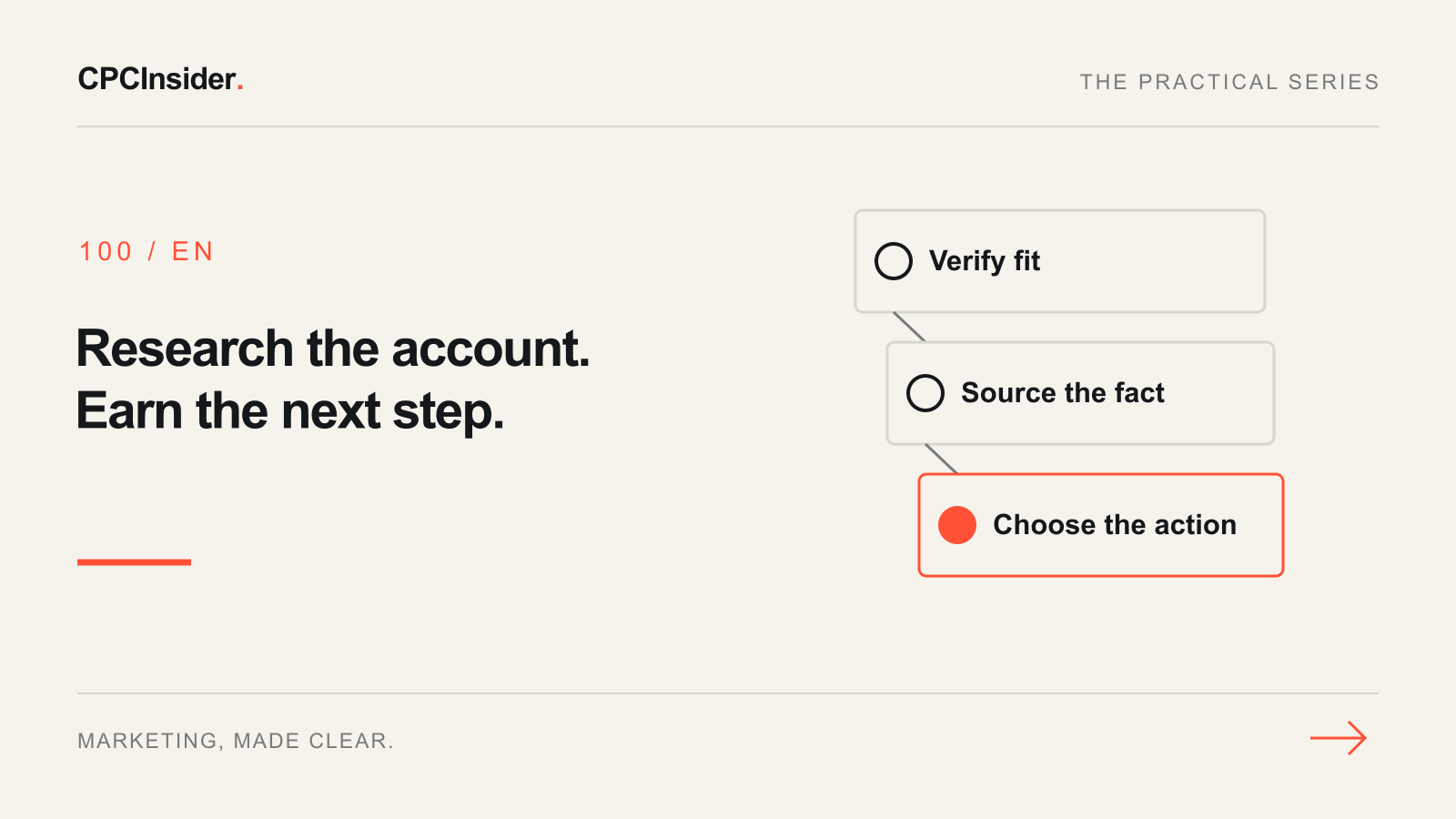
Build a useful prospecting brief: check company fit, verify the buying situation and choose a relevant next step before contacting anyone.
Vladlens Kecko · · 4 min read
Your prospect list is growing, but every message still sounds generic. Open one company record before writing another introduction. Can you explain why that company could use your offer, using something you have actually checked?
Sales prospecting finds potential customers and prepares relevant conversations. Salesforce's prospecting guide distinguishes finding suitable accounts from developing them into opportunities. The workflow below is our practical research sheet; it does not send messages or turn an observed signal into permission to contact someone.
1. Define who you can help
Choose one service, the business problem it addresses and the delivery limits. Write down genuine exclusions: unsupported requirements, locations you cannot serve or a purchase the business does not make. Keep unknown information separate from confirmed poor fit.
Use the market-segmentation worksheet for the broader customer groups. Prospecting works at the individual account level: which evidence makes this particular company worth investigating?
2. Build an account brief with sources
| Field | What to record | When evidence is missing |
|---|---|---|
| Business fit | Relevant product, operation or customer group; source URL and date | Research further or leave unconfirmed |
| Possible need | An observed change and the problem it might create | Label the need as a hypothesis |
| Buying role | Relevant function, verified from a current public source | Avoid guessing a person's authority |
| Useful contribution | A resource or question tied to that situation | Rework the angle before contacting |
| Next decision | Research, appropriate contact, defer or exclude | Name the missing fact and an owner |
A recruitment advert, site update or public announcement is evidence of that event. It does not prove an active budget or dissatisfaction with a supplier. Preserve the original wording and distinguish it from your interpretation. Do not copy personal contact details into a broadly shared marketing sheet.
3. Check the message against the brief
Remove praise that could apply to any business. State the relevant observation without pretending to know the company's internal situation. Ask a bounded question that the intended recipient can answer, or offer a useful resource with a clear purpose.
Check your normal contact-permission, privacy and suppression process before any outreach. A public profile is not blanket permission. This guide provides research preparation, not a jurisdiction-specific legal assessment or an automated outreach sequence.
4. Choose the next action honestly
If fit is confirmed but need is unknown, use discovery rather than a proposal. If a company is outside delivery scope, remove it from the active list with a reason. If the evidence is stale, refresh it before writing. A non-response does not establish poor fit or justify repeated messages indefinitely.
Use the sales-pipeline stages only once the record meets your actual entry criteria. Do not count researched companies as sales opportunities to make the pipeline look larger.
Before the next prospecting session
- Can a colleague open every supporting source?
- Are facts, assumptions and unknowns visibly separate?
- Is the proposed question specific to the account?
- Is the contact route appropriate under your current process?
- Does every deferred record have a reason and review condition?
Review whether research produces relevant conversations and accepted opportunities, alongside the time it takes. Message volume alone cannot answer that question.
Check whether the account is already a customer, an active opportunity or assigned to a colleague before proposing contact. Reuse the existing record rather than creating a parallel outreach track.
Turn research into a usable acquisition process
Explore B2B lead-generation support or request a free 30-minute founder-led growth review. You receive a short written plan with three priorities, with no obligation to hire CPCInsider.
About the author
Free founder-led growth review
Know where to focus your next marketing investment.
In a focused 30-minute conversation, we review your advertising, website and sales follow-up together. Afterwards, you receive a short written action plan you can use with your own team or with ours.
Your biggest growth gaps
See where your ads, website or follow-up may be losing potential customers.
Your next 3 priorities
Get a ranked action list with the reason for each recommendation and what to check next.
A practical starting plan
Leave with clear next steps for your team, plus our recommendation if you want help implementing them.
Continue reading
Market segmentation: choose a customer group your team can actually serve
Compare customer groups by their needs, buying situation and delivery fit. Includes a fictional B2B example and a practical segment-selection worksheet.
Sales pipeline stages: define the evidence before moving a deal
Define sales pipeline stages with buyer evidence, clear exit criteria and a next-action owner. Includes a fictional CRM worksheet and weekly review checklist.
B2B lead generation in Latvia: a system sales can trust
Build a B2B lead-generation system with clear customer fit, an offer, qualification and CRM follow-up. Check each handoff from enquiry to sales.