Growth Strategy
Sales pipeline stages: define the evidence before moving a deal
Define sales pipeline stages with buyer evidence, clear exit criteria and a next-action owner. Includes a fictional CRM worksheet and weekly review checklist.
Vladlens Kecko · · 6 min read
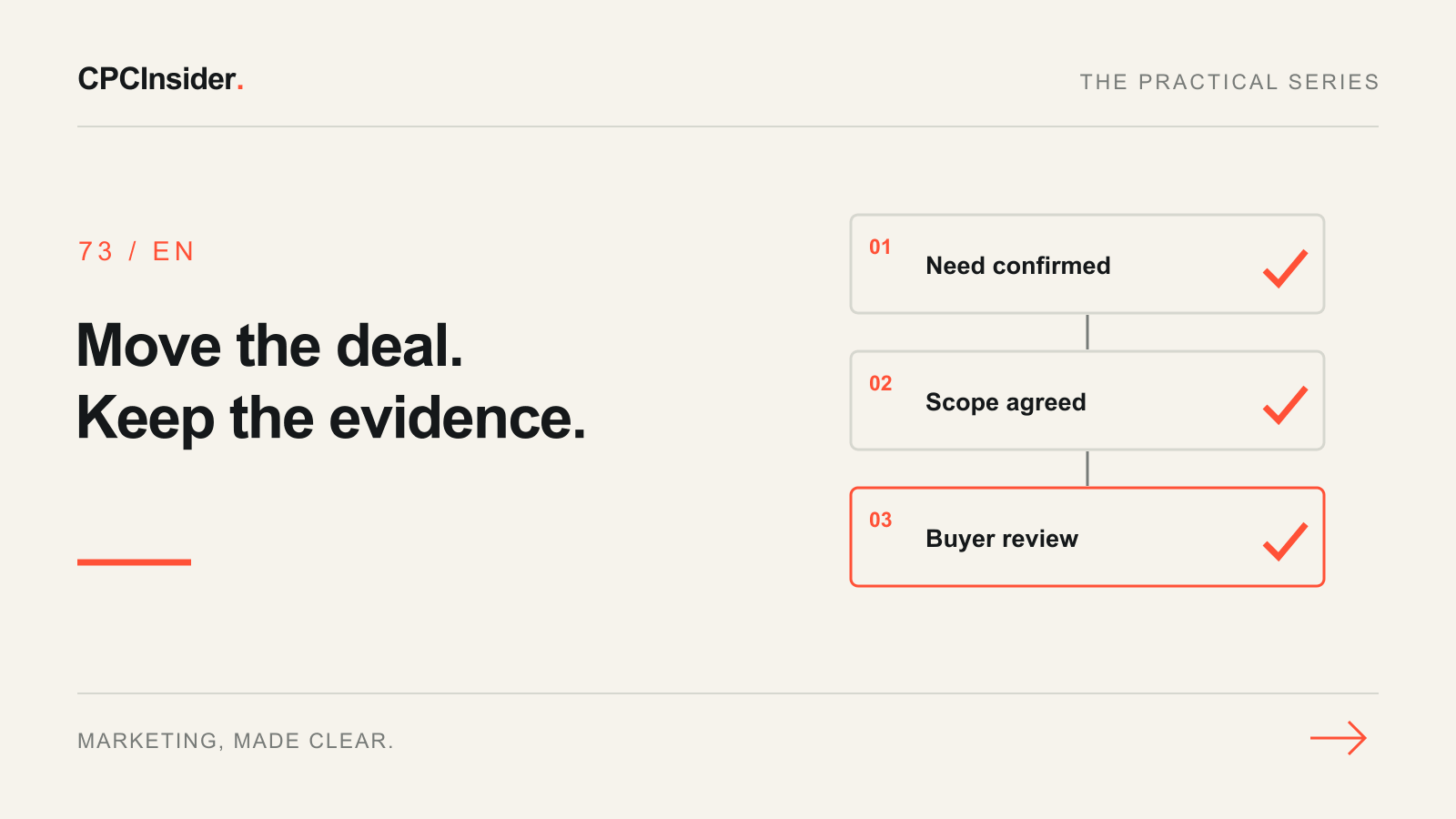
Sales pipeline stages describe where an opportunity stands in your selling process. A useful stage requires evidence, not just a task someone completed. “Proposal sent” says what the seller did; it does not establish that the buyer has agreed on scope, timing or the decision process.
Salesforce's pipeline-stage guide explains how stages help teams inspect sales progression. The worksheet below is our practical starting model for a service business. Adapt it to your buying process; these are not mandatory CRM settings or universal conversion benchmarks.
1. Decide what belongs in the pipeline
Keep raw enquiries separate from accepted opportunities. Agree the minimum evidence of customer fit and a relevant need before creating an opportunity. A newsletter signup alone need not become a deal. Use the lead-scoring worksheet for initial prioritisation, then let a person verify the buying situation.
Choose one opportunity per distinct buying decision. Two contacts at the same company discussing the same project should not automatically become two forecast deals. Record a reason when separate budgets or projects justify separate records.
2. Copy an evidence-based stage worksheet
This fictional service-sales model starts after initial qualification. “Next stage” means the agreed condition is met, not that the team wants the dashboard to look healthier.
| Stage | Evidence required to enter | Evidence needed to progress |
|---|---|---|
| Need confirmed | Buyer describes a relevant problem and accepts a next conversation | Problem, affected team and desired outcome documented |
| Scope agreed | Buyer and seller confirm the work to evaluate | Proposal requirements and decision participants understood |
| Proposal under review | Proposal received by the agreed person | Buyer confirms remaining questions and a review step |
| Decision pending | Commercial and delivery questions are resolved or explicitly tracked | Explicit acceptance or a recorded decision not to proceed |
| Won / lost | Acceptance evidence or confirmed loss reason | Delivery handoff for won; reason and permitted future action for lost |
For every open deal add an owner, next action, action date, last meaningful buyer interaction, estimated value and expected decision date. Distinguish an estimate from an agreed commitment. Choose a value basis such as first-contract revenue and apply it consistently; do not mix monthly fees with annual contract totals.
3. Test the definitions against three real records
Use an authorised CRM view, not a spreadsheet containing copied personal contact data. Ask two colleagues to classify the same three opportunities independently. If they choose different stages, discuss the missing evidence and tighten the definition before migrating the whole pipeline.
In a fictional example, record A has a sent proposal but no confirmed recipient; it does not meet “proposal under review”. Record B has a scheduled buyer review with open implementation questions; it remains under review. Record C has written acceptance and a delivery owner; it can be marked won under this model. None of these examples predicts a win probability.
Do not treat a seller's “90% confidence” as a calibrated forecast. Stage probabilities need enough relevant closed-history data and periodic validation. A small business can start with unweighted value and clear uncertainty rather than inventing precise probabilities.
4. Run a short weekly exception review
Salesforce's management guide recommends regular reviews and accurate CRM updates. Our proposed agenda concentrates on exceptions: missing next actions, repeatedly postponed decisions and records whose evidence no longer fits their stage.
Ask what changed in the buyer's situation, what evidence supports the current stage and who owns the next step. Set an inactivity review threshold appropriate to the sales cycle. An unanswered message is a reason to investigate, not proof that the buyer is unqualified or has rejected the offer.
Move an opportunity back when evidence warrants it and record why. Close a genuinely lost deal with a useful reason; do not keep it open merely to protect pipeline totals. Never invent a deadline or pressure a buyer to improve a report.
5. Feed the learning back into marketing
Compare opportunities created in the same period, allowing time for the normal sales cycle. Separate still-open records from losses. Repeated scope confusion can justify clearer offer information; a capacity problem may need an operational decision. Neither conclusion follows from total pipeline value alone.
Use the marketing-to-sales system guide for the initial handoff and the CRM measurement guide for outcome feedback. A CRM stage change is not automatically a correctly configured advertising conversion.
Before you use the new stages
- Each stage has an observable entry and exit condition.
- One buying decision is not counted twice.
- Every open record has an owner and dated next action.
- Amounts use the same commercial basis.
- Won and lost definitions have evidence; open is reported separately.
- The team tested definitions before changing its production CRM.
Choose the next useful improvement
Our business growth service connects acquisition and sales execution. Book a free 30-minute founder-led growth review. We will discuss the main constraint and provide a short written plan with three priorities, with no obligation to hire CPCInsider.
About the author
Free founder-led growth review
Know where to focus your next marketing investment.
In a focused 30-minute conversation, we review your advertising, website and sales follow-up together. Afterwards, you receive a short written action plan you can use with your own team or with ours.
Your biggest growth gaps
See where your ads, website or follow-up may be losing potential customers.
Your next 3 priorities
Get a ranked action list with the reason for each recommendation and what to check next.
A practical starting plan
Leave with clear next steps for your team, plus our recommendation if you want help implementing them.
Continue reading
Lead scoring: a practical worksheet for fit, intent and follow-up
Build a simple lead-scoring model without confusing activity with buying intent. Includes a fictional scoring example, review checklist and handoff rules.
B2B lead generation in Latvia: a system sales can trust
Build a B2B lead-generation system with clear customer fit, an offer, qualification and CRM follow-up. Check each handoff from enquiry to sales.
Google Ads conversion tracking for B2B: from click to revenue
Track Google Ads beyond form submissions. Preserve click sources in CRM, define qualified leads and connect campaign costs with won customers and revenue.