Measurement
Brand awareness: build a measurement plan beyond impressions
Separate exposure, recognition and demand signals. Build an awareness measurement sheet without treating reach, direct traffic or branded searches as proof of lift.
Vladlens Kecko · · 4 min read
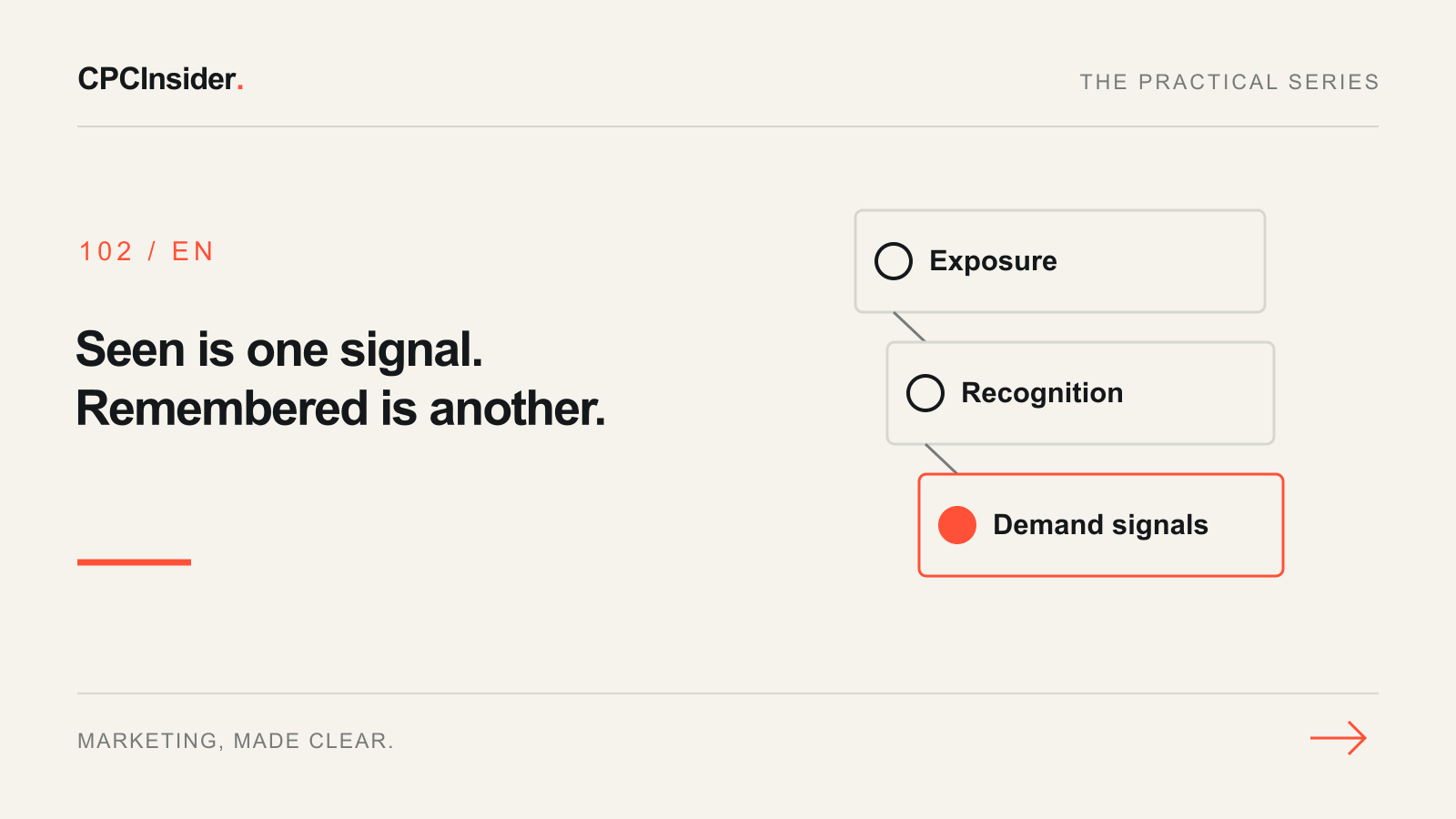
The campaign reached people. Does that mean they remember your business? Start by separating exposure from recognition. An impression tells you an ad was shown under the platform's definition; it does not answer whether someone can identify the brand later.
Brand awareness concerns familiarity with a business and its identifying assets. Amazon Ads' overview discusses recognition, consistent branding and several measurement approaches. The planning sheet below is our suggested way to keep those different signals distinct.
1. Name the audience and memory you want to build
Choose a customer group, a relevant buying situation and the association you want them to retain. Define the geography and language before comparing results. A broad campaign seen outside the delivery area may generate exposure without serving your intended audience.
Check the positioning statement and actual creative together. If the logo, service or useful association is difficult to identify, fix that ambiguity before interpreting awareness metrics.
2. Give each signal its proper job
| Signal | Useful question | What it cannot establish alone |
|---|---|---|
| Platform impressions and reach | Was the campaign delivered, and to whom? | That people remember the brand |
| Recognition or recall research | Can the sampled people recognise or name it? | A result for everyone outside the sample |
| Relevant branded searches | Did observed search demand change? | Which campaign caused the change |
| Site visits and enquiries | Did measurable activity change? | That exposure created incremental demand |
Record the provider's definition and reporting window beside every metric. Reach and impressions are different units; do not add reach across platforms as if the same person cannot appear twice.
3. Keep the research question neutral
If you conduct a survey, decide who should answer, how they are recruited and whether the question is aided or unaided before collecting responses. Asking people to name brands and showing them a brand list are different tasks. Keep wording and recruitment comparable between waves.
Record the number of responses, missing answers and obvious sampling limits. A customer-email survey describes the responding customer group, not automatically the entire market. Small samples should guide further questions rather than a precise market-wide claim.
4. Check tracking before interpreting demand signals
Google's direct-traffic documentation explains that direct traffic can include visits with missing referral information. A rise in direct sessions is therefore not a clean awareness measure. Test campaign links and redirects with the UTM naming guide.
For branded search, retain the exact query group, country, device and complete dates. Check whether position, coverage or new pages changed. Record promotions, distribution changes and other activity that could explain the pattern.
5. Decide the next improvement
If delivery missed the intended audience, inspect distribution. If exposure is recorded but recognition remains unclear, improve the research before declaring success. If people recognise the brand but cannot explain its relevance, review the message and buying situation. Sales performance requires its own commercial analysis.
Your review checklist
- One audience, geography, language and buying situation.
- Separate delivery, recognition and demand rows.
- Stable definitions and comparable reporting dates.
- Survey sample and recruitment limitations recorded.
- Tracking issues and other campaign activity noted.
- One owner, one next action and a review date.
Use the weekly marketing scorecard to retain decisions. An observed change is a reason to investigate; proving incremental lift normally needs an appropriate comparison design.
For an unaided question, do not show the logo, brand name or a branded invitation first: that would supply the answer you intended to measure. Document the actual question order as well as the wording.
Build a clearer measurement plan
Explore strategy support or request a free 30-minute founder-led growth review. You receive a short written plan with three priorities, with no obligation to hire CPCInsider.
About the author
Free founder-led growth review
Can you trust the numbers behind your decisions?
In a focused 30-minute conversation, we review your advertising, website and sales follow-up together. Afterwards, you receive a short written action plan you can use with your own team or with ours.
Your biggest growth gaps
See where your ads, website or follow-up may be losing potential customers.
Your next 3 priorities
Get a ranked action list with the reason for each recommendation and what to check next.
A practical starting plan
Leave with clear next steps for your team, plus our recommendation if you want help implementing them.
Continue reading
Positioning statement: write a claim your sales team can prove
Define the buyer, buying situation, alternative and credible difference. Build an internal positioning statement with a proof table and a fictional example.
How to build a weekly marketing scorecard for your team
Create a weekly marketing report with defined KPIs, owners and next actions. Use lead-generation and ecommerce examples to turn numbers into decisions.
How to create a UTM naming convention your team can use
Stop splitting campaign reports across inconsistent UTM tags. Use a clear naming template, example links and a GA4 checklist before every launch.