Growth Strategy
Affiliate marketing for a business: check the economics before recruiting partners
Plan an affiliate programme with clear qualifying orders, commission economics, tracking checks and return handling before recruiting partners.
Vladlens Kecko · · 4 min read
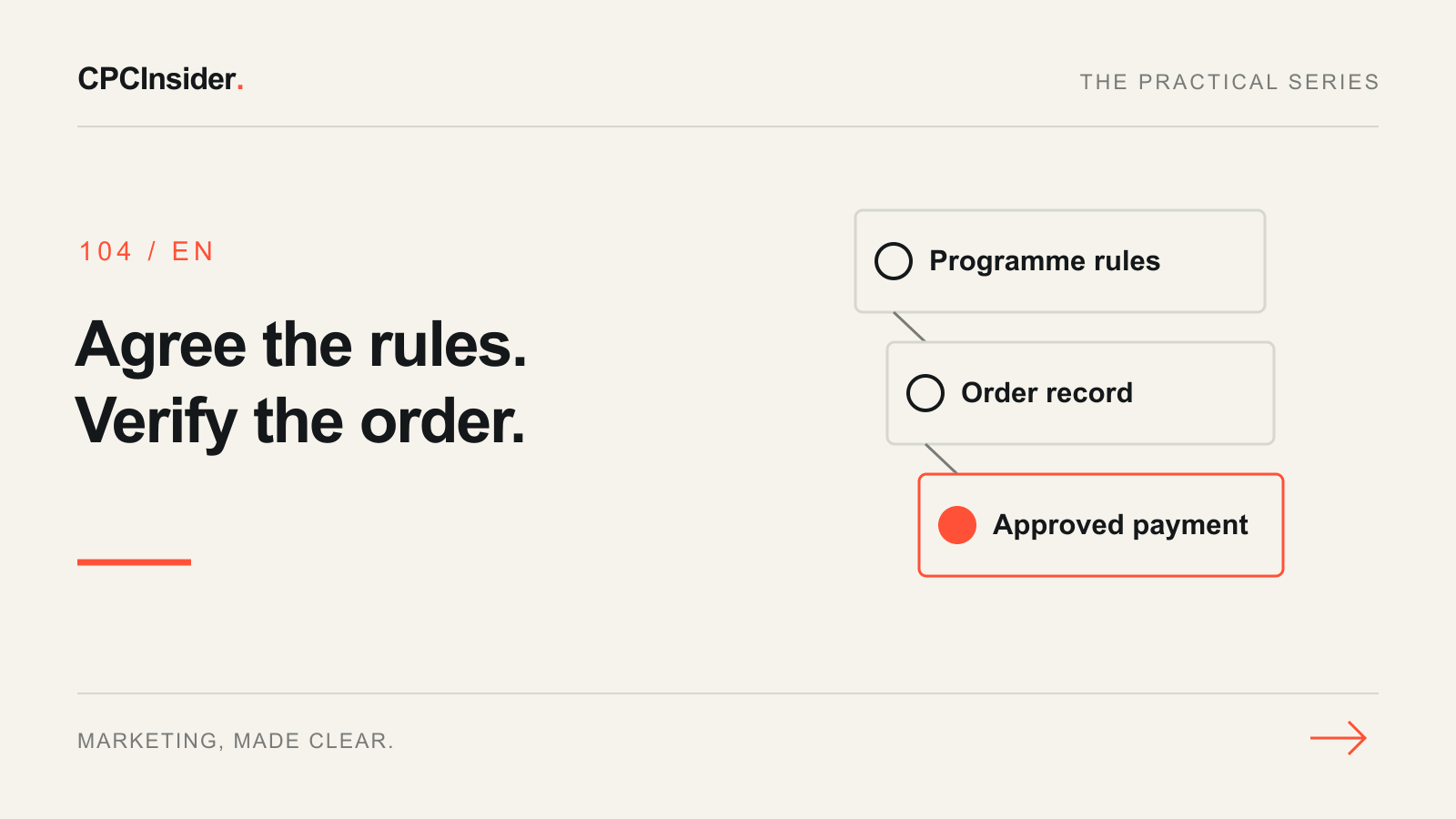
You want partners to bring sales, but nobody has defined which orders earn commission. Start there. An affiliate programme becomes difficult to operate when marketing promises a payment before finance, fulfilment and tracking agree what qualifies.
Affiliate marketing rewards partners for qualifying actions under a programme's rules. Shopify's merchant guide covers commission structures, partner recruitment and performance tracking. Our pilot checklist focuses on the decisions a business should settle before launch, rather than recommending a universal commission rate.
1. Define the payable action and its economics
Choose the product or service, qualifying action and eligibility conditions. State whether cancelled, refunded, duplicate or self-referred orders qualify. Separate an attributed order from an approved commission and a completed payout.
Build the economics with finance using actual costs. Start with net collected revenue after discounts, excluding tax. Subtract applicable product or delivery costs, fulfilment, payment fees, expected returns not already recognised, partner commission and programme costs. Avoid subtracting a cost twice if it is already included elsewhere. Agree which remaining contribution the business needs.
Use the marketing-budget worksheet for cash commitments. Revenue attributed to a partner is not the same as profit or additional sales caused by that partner.
2. Write the operating rules
| Decision | Record before launch |
|---|---|
| Qualification | Eligible product, customer, territory and order state |
| Attribution | Supported link or code, credit window and conflicting-partner rule |
| Commission | Basis, exclusions, approval event and payment process |
| Promotion | Permitted claims, channels and brand-search or coupon restrictions |
| Returns | Reversal rule, review timing and owner |
| Evidence | Order reference, partner reference and a traceable decision |
These are planning fields, not terms that CPCInsider has enabled for you. Confirm the actual capabilities and current terms of your existing platform. Do not invent a standard attribution window or assume every tool handles discounts and returns identically.
3. Trace the link to an order
Shopify's tracking explanation describes connecting partner activity to conversions. Test your chosen method through the real journey: open the link, follow redirects, complete an authorised test order and inspect the partner and order references. Use the platform's legitimate test procedure rather than manufacturing a customer purchase.
Check mobile journeys, eligible codes, duplicate reporting and the cancellation or refund path. Record cases where consent choices, browser restrictions or cross-device journeys limit attribution. Keep order and customer data within approved systems. A UTM tag supports reporting but is not by itself a commission ledger.
4. Check promotion and disclosure
Give partners approved product facts and claims. Agree how commercial relationships will be disclosed under applicable rules and platform requirements. The FTC's disclosure guide provides U.S. guidance; it is not a substitute for checking rules covering your business and audience.
Review actual placements rather than approving a partner solely from audience size. Check that the promoted offer and destination agree. Do not authorise advertising, copied reviews or paid usage rights by assumption.
5. Review a bounded pilot
Keep attributed orders, approved orders, reversals, commissions and contribution separate. Compare relevant customer and product groups; existing customers and coupon-driven purchases can change the mix. Attribution alone cannot prove incrementality.
Before expansion, confirm working tracking, an owner for disputes, accurate claims, affordable contribution and an agreed review date. If orders cannot be reconciled, fix that process before recruiting more partners.
Reconcile a refund through to the commission record before the first partner payout. An approved order and a reversed order must not both remain payable for the same purchase.
Plan the next acquisition test
Explore business-growth support or request a free 30-minute founder-led growth review. You receive a short written plan with three priorities, with no obligation to hire CPCInsider.
About the author
Free founder-led growth review
Know where to focus your next marketing investment.
In a focused 30-minute conversation, we review your advertising, website and sales follow-up together. Afterwards, you receive a short written action plan you can use with your own team or with ours.
Your biggest growth gaps
See where your ads, website or follow-up may be losing potential customers.
Your next 3 priorities
Get a ranked action list with the reason for each recommendation and what to check next.
A practical starting plan
Leave with clear next steps for your team, plus our recommendation if you want help implementing them.
Continue reading
Small-business marketing budget: a monthly template and example
Build a small-business marketing budget with a worked €3,000 example. Track commitments, forecast overspend and decide what to fund next without guesswork.
How to create a UTM naming convention your team can use
Stop splitting campaign reports across inconsistent UTM tags. Use a clear naming template, example links and a GA4 checklist before every launch.
How to calculate break-even ROAS before increasing ad spend
Calculate break-even ROAS using product costs, payment fees, shipping and returns. Follow a euro example and distinguish advertising revenue from profit.