Lead Generation
Account-based marketing: build your first target-account list
Choose target companies, map who makes the buying decision and assign a sales owner. Use the worksheet to decide whether your team should run a pilot.
Vladlens Kecko · · 7 min read
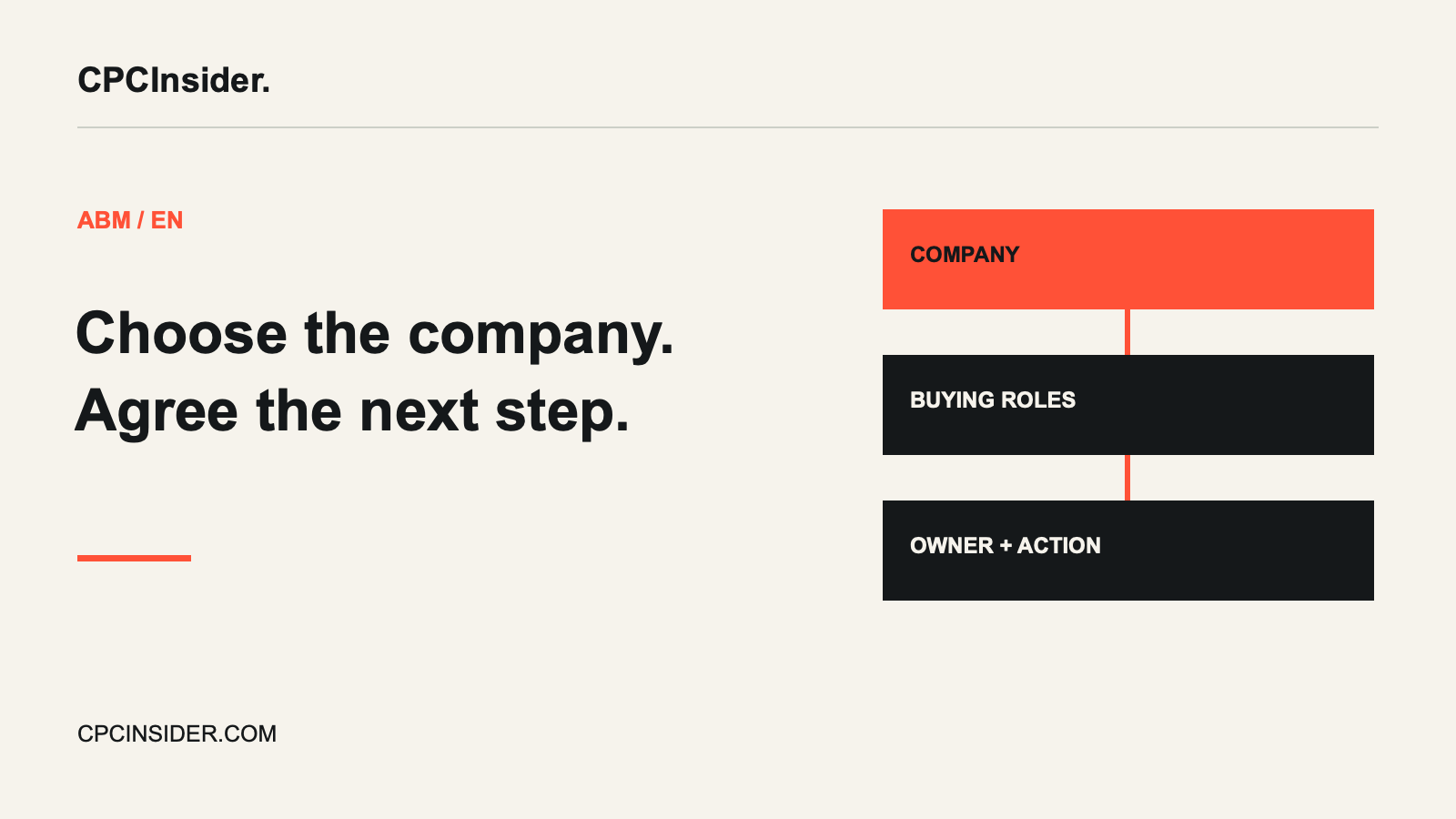
Your team has a list of companies it wants as customers. Before buying ads for that list, ask a salesperson to choose one company and write down why it fits, what buying need you can verify and who owns the next action. A logo and a job title leave too much unanswered.
Account-based marketing (ABM) means coordinating marketing and sales around named companies. Use this worksheet to decide whether your team has enough evidence and capacity for a pilot. For the wider acquisition process, start with the B2B lead-generation system.
1. Choose the buying situation
Write one sentence describing the business problem your offer can address. Include an event you can check, such as a published expansion plan, a relevant vacancy or a buyer who has asked about replacing a system. Record the source and its date.
Record a vacancy as an observation and ask whether the role concerns the problem you solve. Leave budget and purchase timing unknown until you have evidence. If the signal is weak, keep the company in research and write the question that would resolve the uncertainty. If your team cannot explain why the offer fits, remove the company from this pilot.
Salesforce’s ABM guidance describes coordinated work around selected accounts and starting with a pilot. Your selection criteria still need to reflect your own delivery capacity.
2. Agree what earns a place on the list
Have sales and marketing use the same fields. Start with a few companies your team can research and serve. Choose the list size from the time available for follow-up, research and delivery.
| Worksheet field | What to record | Decision it supports |
|---|---|---|
| Company and website | Verified trading name and correct domain | Avoid duplicates and mistaken identity |
| Offer fit | The need you can address and the service limits | Include or exclude |
| Buying signal | Source, date and what remains unknown | Contact or research further |
| People involved | User, budget owner and other approval roles, where known | Choose a useful question |
| Sales owner | One person who accepts the next action | Check capacity |
| Next action and date | Specific task and a scheduled review | Continue, pause or remove |
| Progress evidence | Buyer response, agreed requirement or accepted next meeting | Review actual movement |
Keep uncertain fields visible. Do not fill them with guessed contact information or treat a job title as proof of purchasing authority. For individual company research, use the sales-prospecting checklist.
3. Map the buying group
Ask who will use the service, who will evaluate it and who can approve the commitment. One person may cover several roles. A larger company may need several people for one role.
Record known roles and unanswered questions on the company record. Give the salesperson a relevant resource or demonstration for the next conversation. A finance owner may need cost assumptions; a delivery manager may need to see how implementation will affect the team.
Use the customer journey worksheet to connect each question with an answer the team can provide. Check that the resource addresses the company’s stated need before sending it.
4. Test the worksheet with a fictional company
Suppose a software company wants to offer onboarding support to a manufacturer that has announced a new site. The announcement supports an expansion signal. It gives no evidence that the manufacturer wants this software.
The account owner checks whether the offer suits the manufacturer’s operating model, records the announcement and prepares a question about onboarding at the new site. If an existing relationship provides a suitable introduction, the owner can use it through an approved contact process.
If nobody owns the account or the team cannot explain the need, pause the pilot for that company. Advertising to more employees will not resolve those missing decisions. This scenario illustrates the worksheet; it contains no client results.
5. Choose a channel after agreeing ownership
Your team can use account research, relevant content, existing relationships and paid distribution together. Choose the channel after agreeing which companies and buyer questions you want to address.
If you use LinkedIn Company Targeting, follow its current account-list guidance. Check the matched companies and the resulting audience before launch. Record audience matching separately from buyer intent, purchasing authority and permission to contact someone. Platform availability and audience eligibility need a separate check.
Use the LinkedIn Ads pilot guide for campaign planning. Keep ABM selection and sales ownership in this worksheet.
6. Review progress at company level
Count unique companies and record the agreed next step. Keep ad engagement, identified interest and a qualified opportunity as separate fields. Several form submissions from one company should not appear as several new accounts.
At the review, inspect the evidence behind each stage. Keep an account active when the owner has a relevant next action. Return it to research when a key assumption remains unanswered. Remove it when the offer cannot fit. Record open opportunities separately from won revenue and allow time for the buying cycle.
Before launching
- Sales and marketing agree on the same companies and offer.
- Each buying signal has a source, date and an unanswered-question field.
- An owner accepts the next action for each active company.
- The team can provide a useful answer or demonstration.
- The CRM keeps companies, contacts and opportunities distinct.
- The review uses buyer evidence and records unresolved assumptions.
Review your target-account plan
Bring your draft list to a free 30-minute founder-led growth review. We will discuss the constraint across your offer, acquisition and sales follow-up, then send a short written plan with three priorities. You can use the plan with your team, with no obligation to hire CPCInsider. Implementation scope is agreed separately. Explore our B2B lead-generation service for delivery support.
About the author
Free founder-led growth review
Know where to focus your next marketing investment.
In a focused 30-minute conversation, we review your advertising, website and sales follow-up together. Afterwards, you receive a short written action plan you can use with your own team or with ours.
Your biggest growth gaps
See where your ads, website or follow-up may be losing potential customers.
Your next 3 priorities
Get a ranked action list with the reason for each recommendation and what to check next.
A practical starting plan
Leave with clear next steps for your team, plus our recommendation if you want help implementing them.
Continue reading
B2B lead generation: connect your offer, qualification and CRM
Build a B2B lead-generation system with clear customer fit, an offer, qualification and CRM follow-up. Check each handoff from enquiry to sales.
Sales prospecting: research the account before writing the message
Build a useful prospecting brief: check company fit, verify the buying situation and choose a relevant next step before contacting anyone.
LinkedIn Ads: plan one B2B lead generation pilot
Plan a focused LinkedIn Ads test with one audience and offer. Check Lead Gen Form delivery and judge results using accepted opportunities.