Strategy
Search engine optimization: choose the first useful job for a service website
Build an SEO priority sheet around customer questions, existing pages and indexing evidence. Includes a fictional example and checks before changing content.
Vladlens Kecko · · 6 min read
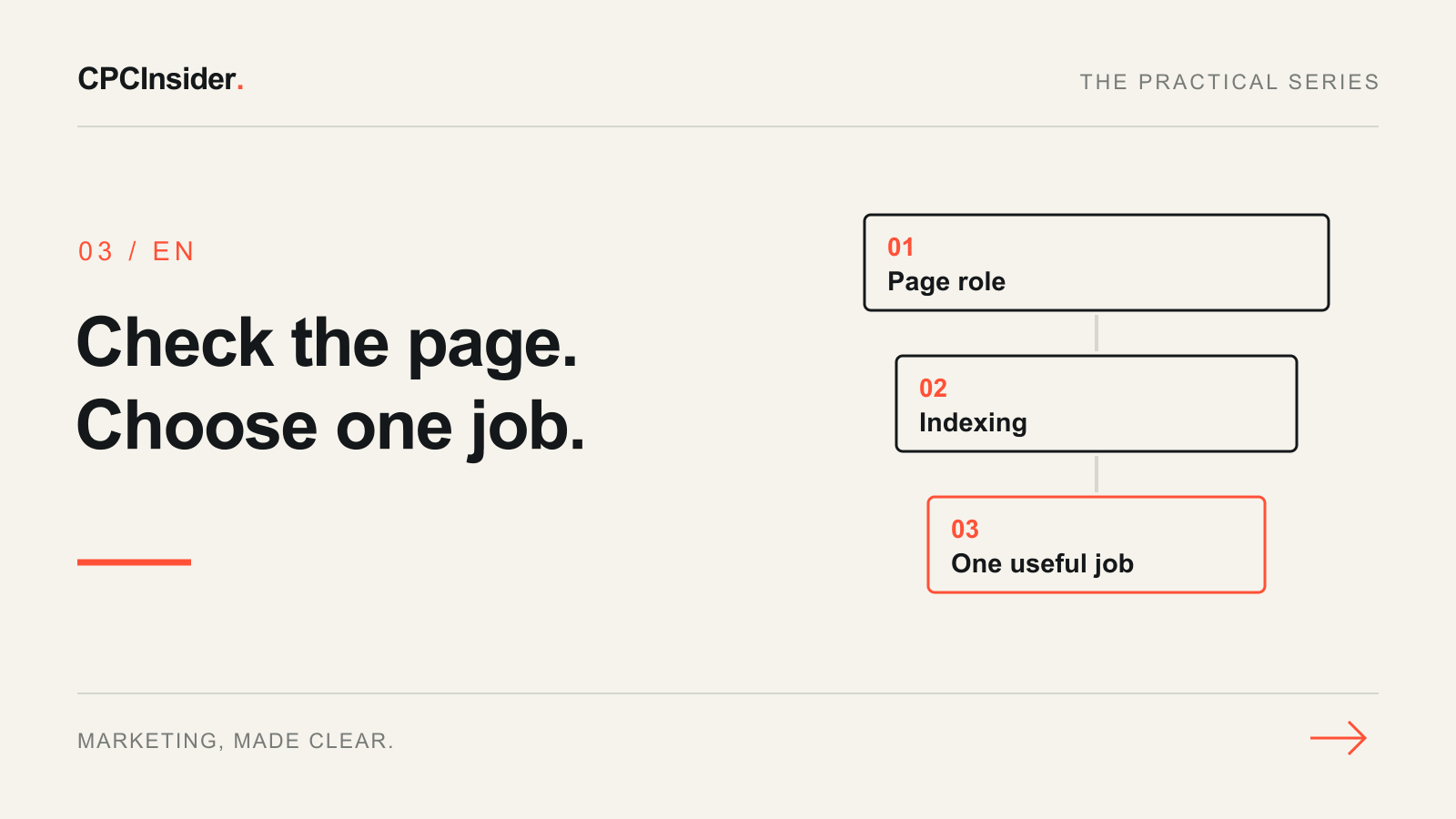
Search engine optimization, or SEO, helps search engines understand a website and people find useful pages through search. For a service business, the practical starting question is not “How many articles can we publish?” It is “Which existing customer journey needs attention first?”
Google's SEO Starter Guide provides the official foundation. The priority worksheet below is our operating plan for selecting work. It does not guarantee indexing, rankings, enquiries or a fixed time to results. Paid-search campaigns are a separate channel.
1. Map a buying question to an existing page
Choose one service and list what a suitable buyer needs to know: scope, fit, evidence, preparation and next steps. Match each question to the most useful current URL. Read the page before deciding that a new article is necessary.
| Customer question | Possible page role | What to inspect |
|---|---|---|
| Is this service appropriate for us? | Service page | Scope, exclusions and a clear next step |
| Have you handled a similar situation? | Case study | Approved evidence and relevant context |
| What should we prepare? | Practical guide | A usable checklist or example |
| Who will help and how do we ask? | About or contact page | Accurate people and a working enquiry route |
Several pages can serve different questions without competing. The task is to clarify their roles, not force every query onto one URL. Use your content production plan when the inventory reveals a genuinely missing answer.
2. Write down a reporting baseline
In the correct Search Console property, record complete dates, query, page, country and device. Look at clicks, impressions and average position together. An impression is not a visit, and a click is not a qualified enquiry.
Separate branded searches from service questions when interpreting demand. A new query mix or a position change can alter CTR without a change in the appeal of your title. Keep the original counts visible; a handful of impressions cannot support a confident performance verdict.
For the on-site journey, the GA4 landing-page guide helps identify what visitors encounter after arrival. Keep its metrics separate from Search Console rather than expecting the two systems to count the same thing.
3. Check the exact page before rewriting it
Google's URL Inspection documentation distinguishes information about the indexed page from a live test. Read the reported canonical and indexing information and note the inspection date. A successful live test does not guarantee inclusion in search results.
If a priority page unexpectedly blocks indexing, redirects somewhere unrelated or lacks its useful content, investigate the technical issue first. Do not remove an intentional exclusion or redirect merely because a report lists it. Ask the site owner or developer to confirm the intended behaviour.
4. Inspect the useful route through the site
Can a reader reach the service, evidence and enquiry step through relevant links? Google's link guidance explains crawlable HTML links and meaningful anchor text. Check actual destinations and task completion, not only menu appearance.
The organic sitelinks checklist covers navigation labels and important destinations in more detail. It cannot configure guaranteed search-result links. A navigation improvement is worthwhile when it helps a customer complete a task, even if Google's displayed links do not change.
5. Choose one job with evidence
This is a fictional planning example for an engineering service company, not a diagnosis of CPCInsider or a reported client result.
| Observation | Proposed job | Completion evidence |
|---|---|---|
| Assessment-preparation information already exists but is hard to find | Add one relevant contextual route to that guide | Correct link visible and usable on phone |
| Service scope is ambiguous | Have the delivery owner review one scope section | Reader can identify included and excluded work |
| A priority URL has an unexpected indexing restriction | Confirm intention and prepare a technical correction | Correct live behaviour and subsequent inspection record |
Pick the job justified by your evidence. Save the affected URL, previous version, owner, exact change and verification plan. Avoid combining unrelated title, layout and content experiments when you want to understand one hypothesis.
Your first-month output
Aim for a clear page-role map, a dated baseline and one verified improvement. Technical completion can be checked immediately; search performance needs recrawl context, complete comparison windows and enough observations. Request a free 30-minute founder-led growth review for a short written plan with three priorities and no obligation to hire CPCInsider.
About the author
Free founder-led growth review
Know where to focus your next marketing investment.
In a focused 30-minute conversation, we review your advertising, website and sales follow-up together. Afterwards, you receive a short written action plan you can use with your own team or with ours.
Your biggest growth gaps
See where your ads, website or follow-up may be losing potential customers.
Your next 3 priorities
Get a ranked action list with the reason for each recommendation and what to check next.
A practical starting plan
Leave with clear next steps for your team, plus our recommendation if you want help implementing them.
Continue reading
Google sitelinks: a practical checklist for making important pages easier to find
Understand organic Google sitelinks and audit navigation, internal links and page labels. Includes a practical destination worksheet for service businesses.
Content marketing: turn one customer question into a usable content plan
Choose one buyer question, gather evidence and build a useful article, worksheet and sales answer. Includes ownership, distribution and review checks.
GA4 landing page report: find the pages worth improving first
Use GA4 landing-page data to choose your next improvement. Compare matched traffic, inspect a worked example and build a page-priority worksheet.