Strategy
Marketing mix: a 4Ps worksheet before you increase ad spend
Use the 4Ps to align your offer, price, buying route and promotion. Includes a service-business example and a practical decision worksheet.
Vladlens Kecko · · 6 min read
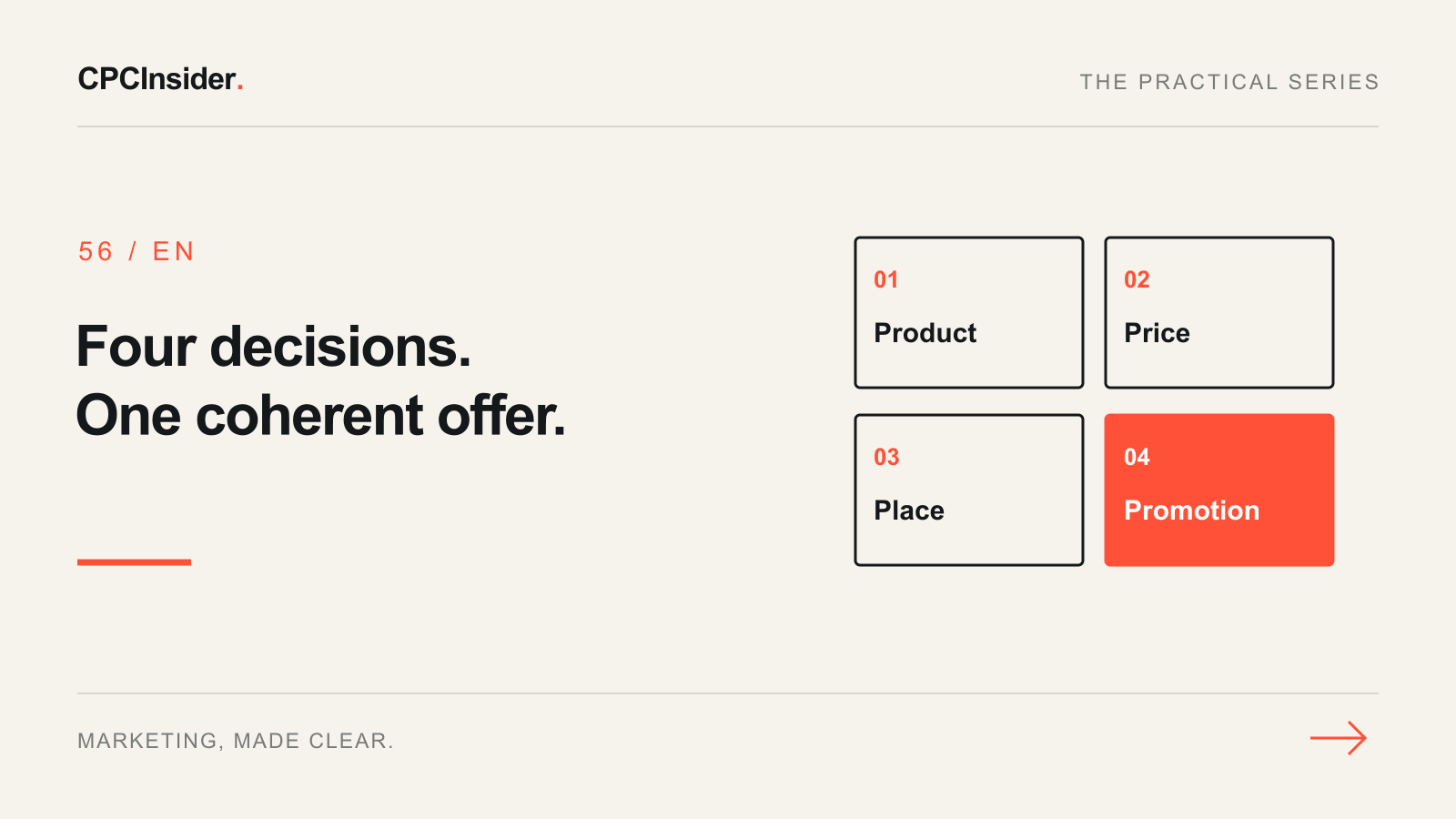
A marketing mix is the combination of product, price, place and promotion. The American Marketing Association describes these four Ps as a framework for marketing decisions. Use them together before treating every growth problem as a need for more advertising.
The output of this exercise is one page: one customer group, four connected choices and one test. It complements a 90-day marketing plan: the mix defines the offer and route to market; the plan assigns the work and timing.
1. Choose one customer and one buying situation
Write who needs the offer, what has happened to trigger the search and what they need to achieve. “Small businesses” is too broad for a useful first draft. A more usable starting point is “an owner hiring their first employee who needs a reliable monthly payroll service”. This is a fictional planning example, not a measured audience segment.
List the questions customers actually ask before buying. Use approved sales notes, enquiry patterns and customer conversations. Separate observed objections from assumptions. If the team cannot name the buyer's problem, adding a channel will not resolve that uncertainty.
2. Product: define what the customer receives
Product includes a service, not just a physical item. Describe the deliverable, boundaries, customer responsibilities and evidence that the offer can meet the need. For the fictional payroll provider, define whether setup, monthly processing and corrections are included; do not let the ad promise a wider service than the team can deliver.
Avoid confusing an internal feature with a customer outcome. Ask which feature helps the buyer complete the job and what proof supports that connection. Record an unanswered question instead of inventing a benefit or guarantee.
3. Price: make the commitment understandable
Price is what the customer pays. For your worksheet, also record the charging basis, what changes the quote and what information the buyer needs to compare alternatives. The BDC marketing-mix guide stresses the connection between the four choices.
For a service sold by quotation, the useful action may be explaining scope and quote inputs. It need not be publishing a fixed price. Check that the promised work can be delivered within your economics before testing a discount. Lower enquiry cost alone does not establish a better commercial result; use the CPC, CPA and CAC comparison to keep the outcomes separate.
4. Place: remove friction from the buying route
Place concerns how the customer obtains the offer. Map the practical route: discovery, enquiry, qualification, agreement and delivery. A physical address alone does not explain that route. For a remote service, the buying path might include an online form and a scheduled conversation.
Record the information the customer needs at each handoff. If the form asks for details the buyer cannot yet provide, test a simpler first step. Preserve enough qualification for a useful response. Do not replace the whole journey when one unclear handoff is the suspected problem.
5. Promotion: match the message to the other choices
Choose the claim, proof and channel after the offer and buying route are clear. A search ad promising an immediate fixed quote will conflict with a service that needs a scope review. Either revise the promise or redesign the actual offer with the responsible team.
Use the following original worksheet in a team session. Every entry is illustrative, not a client result or a CPCInsider service package.
| Choice | Fictional payroll-service entry | Check before launch |
|---|---|---|
| Customer situation | Owner hiring a first employee | Validate the recurring question |
| Product | Defined monthly processing scope | Confirm inclusions and exclusions |
| Price | Quote based on agreed workload | Explain the quote inputs |
| Place | Short form, scope call, written proposal | Test the full handoff |
| Promotion | Clear scope and process explanation | Match claim to visible proof |
| First experiment | Clarify required quote information | Compare suitable enquiries and handling effort |
6. Test one mismatch and record the decision
In the hypothetical business, suppose sales conversations repeatedly begin with confusion about what a quote requires. Start by clarifying that information on the enquiry page while keeping the audience and core offer stable. Assign an owner, record the start date and define what a suitable enquiry means before reviewing results.
Track the relevant outcome and the context: suitable enquiries, follow-up effort and progression to a proposal. Set a review point based on the buying cycle and enough observations to interpret the result. A handful of enquiries can reveal a question worth investigating; it does not prove a conversion uplift. Keep a reversible version and record what remains uncertain.
Before launch, check that the four choices tell the same story, that each claim has evidence, that the buying route works and that the team can fulfil the offer. Then turn the agreed change into a marketing brief with an owner and acceptance criteria.
Get a clear next step for your own business
Our strategy service connects customer priorities, the offer and channel decisions. Book a free founder-led growth review to discuss your advertising, website and follow-up, and receive a written plan with three priorities.
About the author
Free founder-led growth review
Know where to focus your next marketing investment.
In a focused 30-minute conversation, we review your advertising, website and sales follow-up together. Afterwards, you receive a short written action plan you can use with your own team or with ours.
Your biggest growth gaps
See where your ads, website or follow-up may be losing potential customers.
Your next 3 priorities
Get a ranked action list with the reason for each recommendation and what to check next.
A practical starting plan
Leave with clear next steps for your team, plus our recommendation if you want help implementing them.
Continue reading
Marketing plan: a 90-day template your team can use
Build a marketing plan with a free template, a worked example and clear budget decisions. Set priorities, assign owners and measure progress over 90 days.
How to write a marketing brief: a practical one-page template
Write a useful marketing brief before hiring an agency or launching a campaign. Copy ten questions, a worked example and an approval checklist.
CPC vs CAC: why cheaper clicks can cost you more customers
Compare CPC, CPA and CAC with clear formulas and two campaign examples. Use the free worksheet to see whether cheaper clicks really lower customer costs.