Measurement
Call tracking: check whether the phone enquiry actually reached your team
Audit a phone enquiry from the visible number to the call record and CRM. Separate taps, connected calls and qualified outcomes before changing advertising.
Vladlens Kecko · · 4 min read
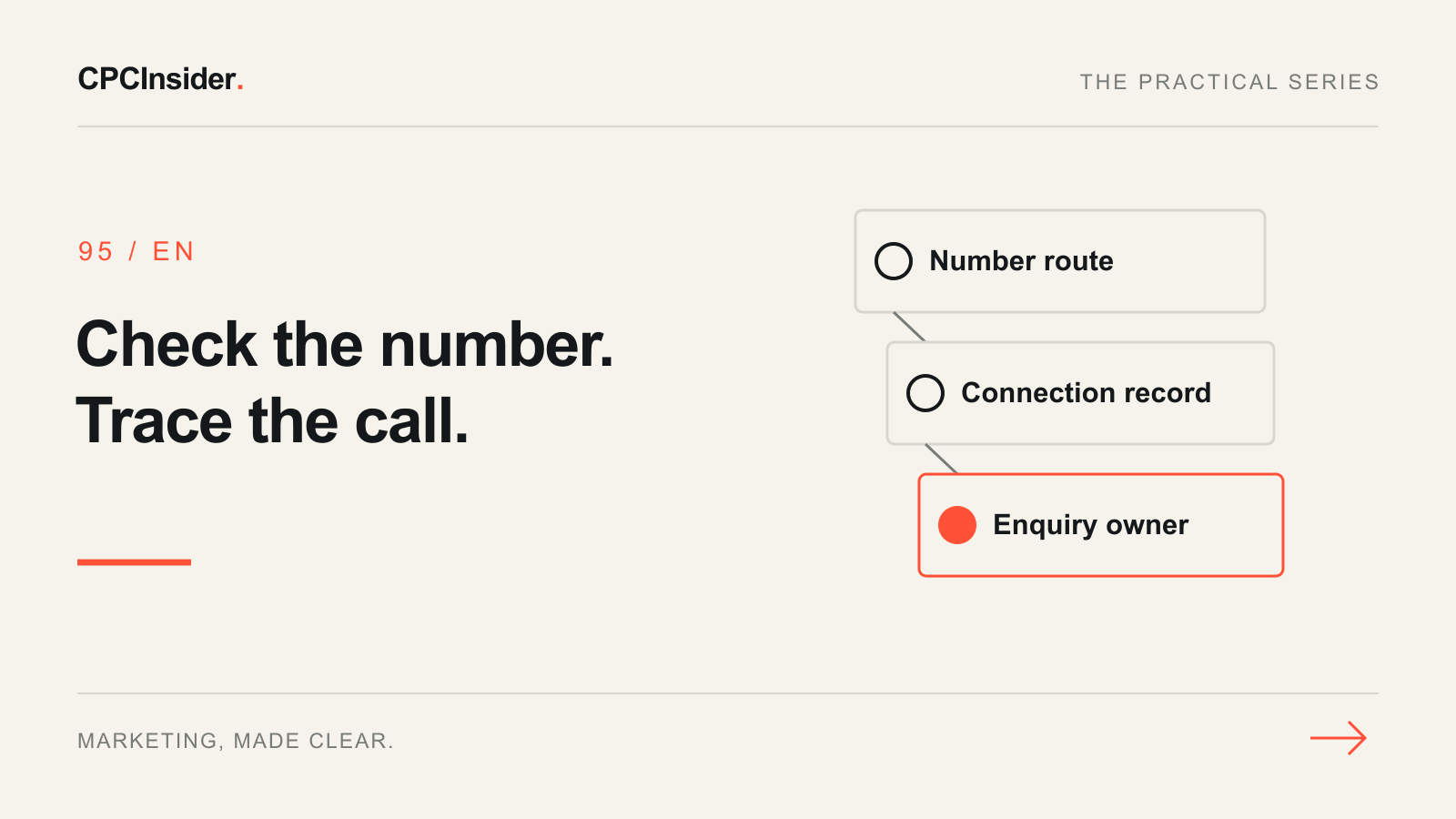
Your ads report phone conversions, but the team says the phone is quiet. Open the conversion action and write down what it measures before changing the campaign. A tap, a recorded call and a sales-accepted enquiry are different observations.
Call tracking connects a phone interaction to its available source and outcome. The useful starting point is one permitted test journey and a record your team can reconcile—not another unexplained conversion total.
1. Name the event behind the number
Use this table to label the existing measurement. Keep its definition beside the report.
| Observation | What it establishes | What still needs checking |
|---|---|---|
| Phone-link tap | Someone activated the calling link | Whether a call connected |
| Connected call record | The telephone system recorded a connection | Whether the caller had a relevant enquiry |
| Platform call conversion | The configured conversion rule was met | The measurement method and commercial outcome |
| Sales-accepted phone enquiry | The team applied its qualification criteria | The next action and eventual outcome |
Google describes several phone-call measurement routes, including duration and, where eligible, recording-based qualification. Its documentation also describes interaction-based classification when call-duration information is unavailable. Inspect the actual setup; do not assume every platform-labelled call proves that a conversation happened.
Check what “connected” means in your telephone log: reaching a recorded menu or voicemail is not evidence that a team member spoke to the caller. Record that outcome separately.
2. Check the number and its route
Record whether the number appears in an ad asset, on the website or in an organic listing. Open the real mobile page. Check that the visible number and calling link reach the intended business route, including any reception or forwarding step. A correctly fired website event cannot repair a wrong telephone destination.
Google forwarding numbers require an eligible country and supported setup. Check availability for the actual business number; do not select another country to force eligibility. Google says its forwarding numbers can change and should not be reused outside the supported tracking context. For website number replacement, follow the current website-call instructions.
3. Reconcile one authorised test
Agree a test with the person receiving calls. Use the provider's approved testing procedure and record the time zone, displayed number, destination, connection result and expected measurement rule. Compare the permitted telephone log with the event or platform record after its processing interval. Keep customer phone numbers out of shared diagnostic notes; use a test reference or authorised internal ID.
Then confirm that the team can create or locate the matching CRM enquiry, name an owner and record its disposition. Our CRM measurement guide covers the wider advertising-to-sales chain. A missing CRM handoff is a different repair from a missing browser event.
4. Choose the repair from the failed step
If the destination is wrong or the call cannot connect, fix the telephone route first. If the call connects but the expected record is absent, inspect eligibility, conversion conditions and collection before changing bidding. If the record exists but no person owns the enquiry, repair the handoff. When calls are handled but unsuitable, review the recurring qualification reasons with sales.
Do not equate a duration threshold with a confirmed sale. Keep the primary and secondary conversion roles explicit, and review a proposed goal change before applying it to production campaigns.
Keep a reusable check record
Save route, test reference, time zone, expected event, observed connection, CRM ID, owner, unresolved step and retest date. After an approved repair, repeat the same route. Report what the test established and what remains unknown; a successful test does not prove that every historical call was measured.
Our tracking, attribution and CRM service helps connect the records. Book a free 30-minute founder-led growth review for a short written plan with three priorities and no obligation to hire CPCInsider.
About the author
Free founder-led growth review
Can you trust the numbers behind your decisions?
In a focused 30-minute conversation, we review your advertising, website and sales follow-up together. Afterwards, you receive a short written action plan you can use with your own team or with ours.
Your biggest growth gaps
See where your ads, website or follow-up may be losing potential customers.
Your next 3 priorities
Get a ranked action list with the reason for each recommendation and what to check next.
A practical starting plan
Leave with clear next steps for your team, plus our recommendation if you want help implementing them.
Continue reading
Google Ads conversion tracking for B2B: from click to revenue
Track Google Ads beyond form submissions. Preserve click sources in CRM, define qualified leads and connect campaign costs with won customers and revenue.
Primary vs secondary conversions in Google Ads: what should guide bidding?
Choose primary and secondary Google Ads conversions, check campaign goals and avoid duplicate signals. Follow practical GA4 import and verification steps.
Why does Google Ads generate low-quality leads?
Getting Google Ads leads that never buy? Check seven causes across targeting, search terms, landing pages, forms and CRM feedback before changing bids.